
Existential Personalistic Anthropology: A New Lens for a New Era
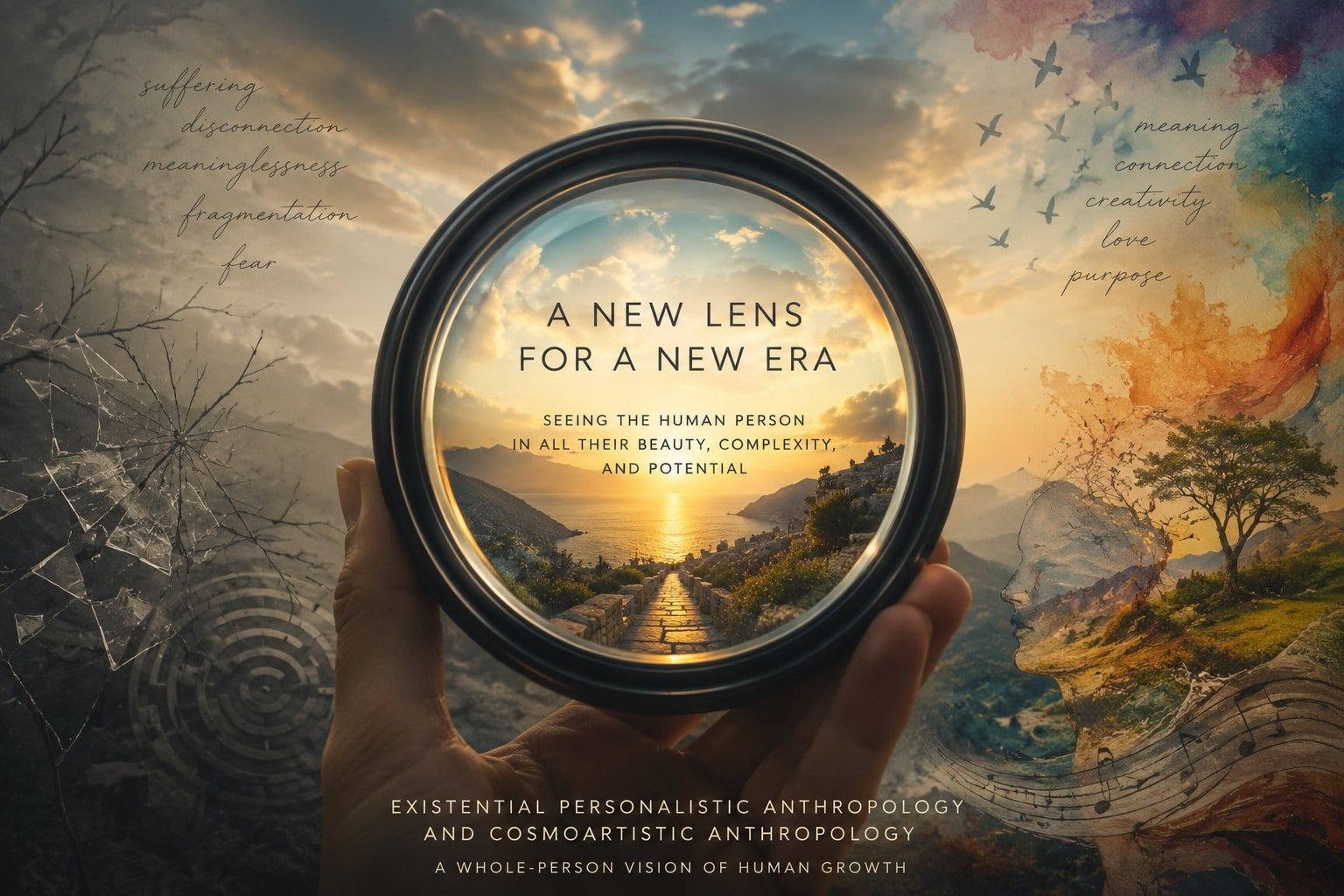
The Philosophy Behind My Work
Existential Personalistic and Existential Cosmoartistic Anthropology are a comprehensive philosophy of human development and a practical approach to counseling developed over more than fifty years by Professor Antonio Mercurio and his collaborators through the Institutes and Centers affiliated with Sophia University of Rome, Italy. Today this work continues through practitioners and training centers in Europe, Russia, Asia, and the United States.
At its heart, this approach asks a simple but profound question:
How can we transform mental, emotional, physical, and existential suffering into a life of greater meaning, freedom, love, and creativity?
Rather than viewing suffering simply as something to eliminate, Existential Personalistic Anthropology sees it as carrying important information about who we are, how we have been shaped by our relationships and experiences, and what life may be asking of us now. Our wounds need compassion and healing, but they can also become the very forces that lead us toward greater authenticity and wholeness.
This approach understands every person as an integrated whole whose body, emotions, mind, relationships, creativity, and spiritual life continually influence one another. Healing is therefore not simply the reduction of symptoms, but the ongoing creation of a life that expresses our deepest values, gifts, and unique vocation.
Existential Personalistic Anthropology draws from psychotherapy, psychoanalysis, existential and humanistic psychology, family systems work, and creative exploration. It values both intellectual understanding and lived experience, recognizing that lasting transformation occurs when insight is embodied and expressed through the choices we make each day.
A distinguishing feature of this tradition is its emphasis on the personal growth of the counselor. Practitioners undergo many years of theoretical study, experiential training, and personal development before completing their diploma. This reflects the belief that the quality of the therapist’s own inner work is as important as any technique, and that we can accompany others only as far as we ourselves have been willing and/or able to grow.
Changing Our Understanding of Emotional and Existential Pain
Most of us grow up believing that emotional pain is something to eliminate as quickly as possible. Anxiety, depression, relationship struggles, addictions, and even many physical symptoms are often viewed simply as problems to be fixed.
Existential Personalistic Anthropology invites us to look at suffering differently.
Rather than seeing our wounds as evidence that something is wrong with us, it understands them as meaningful expressions of our life history. They tell the story of how we have been shaped by our families, our culture, our relationships, and the countless experiences that have influenced who we have become.
This does not mean that suffering should be glorified or endured unnecessarily. Healing remains essential. But genuine healing involves more than making symptoms disappear. It asks us to understand what our pain is trying to communicate and how it might become the beginning of a more authentic way of living.
Antonio Mercurio often said that “the purpose of pain is to create.” When approached with courage, compassion, and support, our deepest wounds can become the very forces that lead us toward greater freedom, love, wisdom, and creativity.
From Victim to Artist
One of the central ideas of Existential Personalistic Anthropology is that every human being has the capacity to become an artist—not necessarily an artist in the traditional sense, but an artist of life.
Our early experiences inevitably condition us. We develop fears, defenses, habits, and ways of relating that once helped us survive but may later limit our ability to live fully. Without becoming aware of these patterns, we often repeat them throughout our lives, feeling trapped by circumstances or by our past.
The work of counseling is not to erase our history but to transform our relationship with it.
As we gradually become aware of our conditioning, we discover that we are not condemned to remain victims of it. We can begin making new choices that reflect our deepest values rather than our old fears.
Little by little, we become active participants in shaping our own lives. Like an artist working with every available color—including the darker ones—we learn to transform even painful experiences into wisdom, compassion, beauty, and meaningful action.
What Do We Mean by "The Person"?
The word person has a special meaning within Existential Personalistic Anthropology.
It does not simply refer to an individual human being. It refers to the deeper dimension within each of us that is capable of freely choosing love, responsibility, creativity, and truth.
Much of our daily life is governed by automatic reactions that arise from our early conditioning. We may react out of fear, shame, anger, or the need for approval without even realizing it.
The Personal Self represents another possibility.
As we develop greater awareness, we gradually learn to respond rather than simply react. We become increasingly capable of acting in ways that honor both ourselves and others.
This movement toward becoming a true Person is beautifully expressed in Mercurio’s motto:
Amo Ergo Sum — “I love, therefore I am.”
Love here is not understood as sentiment or sacrifice, but as the ongoing capacity to create life, freedom, beauty, and wellbeing for ourselves and for those around us.
Life as a Work of Art
Every artist works with whatever materials are available. Some are easy to shape. Others are difficult, unpredictable, or deeply flawed.
Our lives are much the same.
None of us chooses the family into which we are born or the experiences that shape us. Yet we are continually invited to decide what we will create from those experiences.
Life as a Work of Art is the practice of consciously shaping our existence with the same patience, discipline, curiosity, and creativity that an artist brings to a painting, a piece of music, or a sculpture.
This does not mean striving for perfection.
It means learning to embrace both the joys and the sorrows of life, integrating them into a coherent whole that reflects who we truly are becoming.
Healing, relationships, work, creativity, and spirituality all become part of this ongoing artistic process. As we slowly transform our wounds and conditioning into new ways of living and of expressing ourselves, beyond the chains that bound us, we also release an energy that can inspire others to undertake the same kind of process.
What Is Existential Cosmoartistic Anthropology?
Existential Cosmoartistic Anthropology expands this vision beyond the individual.
As we become more integrated within ourselves, we naturally become more capable of contributing to the wellbeing of others and of the larger world of which we are a part.
Human beings are not isolated individuals. We exist within families, communities, cultures, nature, and ultimately within the unfolding evolution of Life itself.
Our choices therefore have consequences that extend beyond our own personal happiness.
Mercurio described this broader vision as Cosmo Art—the conscious creation of greater beauty, harmony, love, and wisdom within ourselves, our relationships, and the world.
In this perspective, personal growth is never only personal. Every act of healing, every authentic relationship, every creative contribution enriches not only our own lives but also the larger human family.
The Vision of Antonio Mercurio
Professor Antonio Mercurio devoted his life to developing a philosophy that integrates psychology, philosophy, science, spirituality, creativity, and the arts into a unified vision of human development.
Among his many original contributions are his writings on the nature of the Person, the psychology of love, the creative role of suffering, and his interpretation of Homer’s Odyssey as a profound guide to human growth and relationship.
Rather than separating psychology from philosophy or spirituality, Mercurio saw them as complementary dimensions of a single human journey: the lifelong task of becoming increasingly capable of loving, creating, and contributing to the evolution of life.
His work continues to inspire psychologists, counselors and therapists of all kinds, as well as educators, scientists, artists, physicians, and thoughtful people around the world who seek ideas and approaches to advance human health and fulfillment that honor both the complexity and the immense potential of every human being.