
The Barbault Basket, Christopher Nolan, Antonio Mercurio, and the Future We Choose
There are moments in history when seemingly unrelated events converge in ways that invite us to pause and reflect.
Whether we understand such moments as meaningful coincidences, synchronicities, or simply the unpredictable intersections of history, they have the power to awaken our imagination and encourage us to ask larger questions.
Over these last few days, one such convergence caught my attention.
At the very time astrologers have identified as the center of the extraordinarily rare planetary configuration known as the Barbault Basket, Christopher Nolan released his long-awaited adaptation of The Odyssey, one of the foundational myths of Western civilization.
No one can say whether these two events are objectively connected. Nor, I believe, is that the most interesting question.
The more interesting question is this:
Why does The Odyssey matter now?
Why has this ancient story returned so powerfully to our collective imagination, to our cultural zeitgeist, at a moment when humanity finds itself confronting unprecedented environmental, political, technological, and moral challenges?
Perhaps great myths never truly belong to the past.
Perhaps they return whenever we need them most.
For more than thirty years, I have read The Odyssey through the work of Professor Antonio Mercurio, the Italian founder of Existential Personalistic Anthropology. Mercurio was convinced that beneath its adventures, Homer’s epic expressed a profound exploration of human transformation.
For Mercurio, Ulysses’ journey was never simply about returning to Ithaca.
It was about becoming capable of freeing ourselves of all the obstacles we can be faced with when trying to become capable of truly loving ourselves and others, while being of service to life.
The monsters, temptations, storms, and shipwrecks were not merely external obstacles. They represented the inner forces that prevent us from becoming fully human: narcissism, unconscious repetition, fear, domination, and our inability to enter into relationships based on mutual freedom rather than possession.
His reading transformed my understanding of the poem.
Yet as I watched Christopher Nolan’s remarkable film, I realized that something else had moved me even more deeply.
Throughout the film, Ulysses is haunted—not by his enemies—but by the suffering he himself has caused.
The destruction of Troy is not presented as a glorious triumph.
It is a wound. By the end of the film, Ulysses’ mind has started going back to the moments when his deceit causes the deaths of so many – all of this caused by the deceitful giving of a gift, something that upends the natural order, or, as Ulysses says in the film “the law of Zeus”.
The deaths of his companions are not simply the inevitable casualties of war.
They weigh upon him. Again and again we see a man who is no longer celebrating his victories but struggling to live with their consequences.
To me, this is the film’s greatest achievement.
Nolan has not simply retold Homer’s story.
He has given us a new vision of what it means to be a hero.
For centuries, Western culture has admired heroes because they conquered. Because they defeated their enemies. Because they proved their strength.
Nolan’s Ulysses offers a different possibility.
His greatness does not lie in his victories.
It lies in his capacity for remorse.
Not remorse that becomes shame or self-hatred.
But remorse that awakens consciousness.
Remorse that allows him to recognize the humanity of those who suffered because of his own actions.
That, to me, is the beginning of true transformation.
Perhaps this is also why the theme of xenia—hospitality and the gift it implies – occupies such an important place in the film.
In Homer’s world, hospitality was not merely good manners.
It was one of the foundations of civilization.
To welcome the stranger before asking who they were was to acknowledge a shared humanity greater than fear.
Today that ancient virtue feels astonishingly contemporary.
We live in an age marked by war, mass migration, deep political polarization often around how countries want to close their doors to the influx of ‘strangers’, and growing suspicion of those who are different from ourselves.
Hospitality, which also implies an understanding that we all have equal standing on the planet tht we share, as well as equal responsibility, is no longer simply an ancient Greek ideal.
It has become one of the defining ethical questions of our own time.
As I write these words, I cannot even step outside my own home and breathe freely.
For days, smoke from immense Canadian forest fires has drifted across Wisconsin, turning the sky into a pale gray veil and making the air hazardous to breathe.
The smoke is more than an inconvenience.
It is a daily reminder that the consequences of human actions do not remain confined to one place, and in the case of global warming, they truly do affect us all. They travel. They cross borders. They enter our lungs, inhibiting our ability to breathe – which ultimately affects our very survival.
They become part of our lives.
Like Ulysses, humanity is beginning to discover that what we do to others—and to the living world—ultimately returns to us.
Perhaps this is why the convergence of the Barbault Basket and Nolan’s The Odyssey has affected me so deeply.
Not because I believe astrology predicts history.
But because symbolic moments sometimes invite us to look at reality with new eyes and to use the information we can gather to make new choices.
Whether or not one finds meaning in the Barbault Basket itself is ultimately a personal matter.
For me, it has become an invitation to pause and ask whether humanity may be standing at one of those rare thresholds where an old way of being has reached its limits, and a new one struggles to be born.
If so, then perhaps the question The Odyssey asks today is not whether we can win.
It is whether we can change, and what our values truly are.
Whether we can look honestly at the suffering we have caused—to one another, to other peoples, to other species, and to the Earth itself—and allow that recognition to transform us.
The film’s closing moments seem to embody precisely this possibility. Rather than ending with conquest or restoration, Nolan gives us something far more moving.
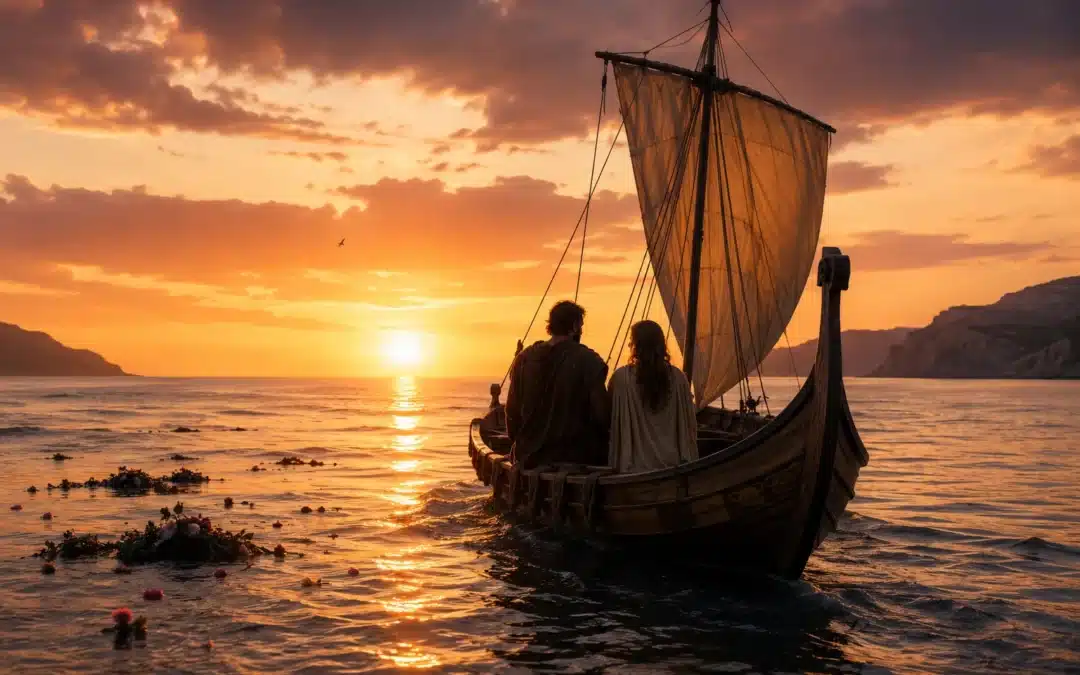
Penelope does not simply welcome Ulysses home; she invites him to sail with her into the future. Together they choose to face the unknown, honor the dead, and create a new life together.
It is an extraordinary ending because it refuses the fantasy that life can simply return to what it once was.
Both have been transformed.
Neither wishes to recover the old world.
Instead, they set sail together carrying memory, grief, responsibility, and a decision to love and to create something new.
To me, this is not only the conclusion of Ulysses’ journey.
It is a vision of what our own civilization might yet become.
Not a civilization that glorifies domination.
Not one that measures greatness by conquest.
But one mature enough to remember, and to feel remorse.
Mature enough to allow remorse to become not an endless expiation, but the beginning of wisdom.
Perhaps this is why The Odyssey has returned to us now.
Not to teach us how to conquer.
But to remind us that the highest achievement of a human being is not victory over others.
It is the courage to become someone who can create beauty after suffering, hospitality after fear, and love after violence.
If Antonio Mercurio was right, Ulysses’ greatest journey was never across the Mediterranean.
It was the journey from unconsciousness to consciousness; from domination to relationship; from power over self and others, to the exquisite kind of power we all have to choose to develop love.
If Christopher Nolan’s film is any indication, perhaps that is the journey humanity itself is now being invited to undertake.
And perhaps there could be no more fitting story for this extraordinary moment in history.
Continue Exploring:
- Existential Personalistic Anthropology: A New Lens for a New Era
- Why We Repeat the Same Patterns
- The Thought and Work of Antonio Mercurio
- Next essay: Penelope and the Future We Choose (coming soon)

Thank you for the perspective and deciphering of the messages brought forth in this epic film!
You’re so welcome, thanks for reading and letting me know you found it valuable! 🙏🏻