Who are you wanting to become? Insights on Healing, Growth and Life as a Work of Art

Who are you wanting to become? Insights on Healing, Growth and Life as a Work of Art

Who are you today, and who are you wanting to become?

Who Are You Today, and Who Are You Wanting to Become?

Lately I have been thinking a great deal about the ways we create ourselves through the lives we live. How we experience and activate the “Artistic I,” as Antonio Mercurio called it: the part of ourselves that knows how to integrate contrasting feelings and experiences to nudge us toward ever fuller Being.

We are not simply born with a fully formed “true self” that we need to uncover. Even though our dreams and desires nudge us toward how we live our lives, new parts of ourselves can come into being through everything we experience — through love and loss, through the frustrations we face regarding those earliest dreams and desires and later ones as well, through our relationships, through the choices we make, through healing old wounds, and through gradually learning to reparent ourselves and recognize and respond with love to our own deepest needs.

Growth, from this perspective, is profoundly creative. It is not something that happens on its own; it requires our attention and our willingness to learn new ways of listening to ourselves and showing up for our own lives.

No one else can do this for us. And yet, when we decide to take ownership of our growth, we soon discover that we are not alone. Not only are there forces within us that are there to help, but we can begin to recognize that other people around us, too, are making their own efforts to grow — even though it may not always look that way to us.

As we become more conscious of the patterns that once shaped us automatically, we gain the possibility of responding differently to situations that are perplexing and painful, or even simply challenging — situations asking us to show up in new ways.

And each time we do, we participate in creating a self — and a life — that did not exist before.

How Life Continues to Create Us

This year has brought that home to me in very concrete ways.

I have welcomed two grandchildren into the world, and each new life has shifted something in me. The arrival of a new generation changes the family system, but it also changes us personally. It gives us a new relationship to continuity, to time, to mortality, to love, to vulnerability, and to the mystery of what will continue after us.

These children did not simply arrive into the life I already had. Their arrival has become part of what is creating me now. As someone who was adopted, seeing these tiny babies and their interactions with their parents, who are connected to me biologically, has allowed me to understand many aspects of my own story — something I have said I was going to be writing about, and I will! But integrating it all within my own mind and heart and soul is taking time. I myself only learned who my biological families are in 2018; it has only been eight years, just a fraction of my life, and… well, I am still letting it all settle and make sense.

Returning to Italy — But Not to the Past

And once again, I am preparing to return to Italy for an extended period.

Italy has always evoked very different dimensions of me than Wisconsin does. There are aspects of myself that seem to come alive there more easily — through the language, the great works of art, the natural beauty, the music, the food, the relationships, the landscape, the sea, and a different rhythm of daily life.

I “discovered” first Milan and then Calabria when I was a very young woman, in search of a way to belong to myself and my life that had been eluding me. When I first went there, I imagined it as being a kind of sabbatical year; instead, it turned into an entire chapter of my life, including a dual career as an English teacher and musician, eventually marriage and children, followed by a return to school to study humanistic psychology and, after more than ten years of arduous study and training, eventually become a counselor in Existential Personalistic Anthropology.

While there I established many important relationships, not only with friends and colleagues, but with the land and culture themselves. My life there profoundly changed me, in ways that are hard to describe. I never truly became “Italian,” even though I did gain citizenship after living there for 24 years, but I most definitely was no longer simply a woman from Wisconsin in the USA, either.

Like many people who end up living in another country, culture, or geographical area different from where they were born and raised, I have been forged by both realities. I am a little bit of each, and my task has increasingly become: how can I integrate the two realities in ways that can nurture me and perhaps inspire and encourage others, too?

I no longer think of my extended stays in Calabria as simply “reclaiming my Italian self.”

The woman who is returning to Italy now is not the woman who lived there twenty or thirty years ago. She has been shaped by everything that has happened since — by my return to live in Wisconsin, by work, relationships, loss, healing, family, creativity, disappointment, joy, and by all the choices that have slowly changed how I experience myself and the world.

What It Means to Honor Our Needs

There is beauty in this movement and in these choices, but there are challenges as well. Growth often asks us to reconsider structures that once worked for us, identities we became accustomed to, and ways of living that may no longer fit.

Being gone for extended periods means not only packing carefully but asking my husband to accept keeping the home fires burning for me as well — most certainly not an easy ask, and for him not an easy response, even though he has learned that by supporting my dreams he benefits as well (and I have done, and do, the same for him).

It means stepping out of the comfort of my daily routine and accepting quite a bit of discomfort while traveling and searching for the kinds of places I want to spend time in.

It means facing all kinds of fears and insecurities. I quite literally almost have a heart attack every time I am on a plane and it hits some turbulence! And even though I know the language and can navigate the normal unpredictability of travel with confidence, because I have traveled quite a bit in the course of my life, it is always fraught with moments of doubt, uncertainty, and no small amount of guilt for how much space I am taking all for myself, away from my family.

It also means carefully planning and managing my finances so I can be comfortable while respecting the limits of my pocketbook. No, I am not rich, and my travels are possible because I make them a priority throughout the year and watch both my income and expenditures very carefully.

This is something I have had to learn, painstakingly, through the years: that becoming more capable of recognizing our true needs also means becoming more responsible for how we respond to them.

And sometimes that requires real courage and real change.

When Life Calls Us to Change

The various moments of our lives offer us specific opportunities that, when we can respond to them with attention, lead us into new versions of ourselves in often very unexpected and wonderful ways.

But the hard thing is that these doorways we are called to walk through do not often open with simple, quiet whispers of the soul, gently beckoning us on! They may only become visible when we experience some kind of pain or are jolted awake by a challenging circumstance.

For me, my “nudges” to reestablish my Italian roots have come mostly through profound inner doubt and struggle. I was pretty sure I was done, settled, set for sitting back and calmly experiencing my older years without the hassle of long plane flights and hauling my guitar around!

But alas, Life has other plans for me….

And since I have been responding to its call to action, despite my fears and trepidation, I have again been feeling a liveliness I thought belonged only to my younger days.

Healing Opens New Possibilities

This is something I see often in the people I work with as well.

Healing is not simply about feeling better or resolving the past. It can open possibilities that did not exist before, and nudge us to make changes that at first glance seem really uncomfortable, difficult, or impossible.

But as we move forward, sometimes step by tiny step, we may become capable of relationships we could not once have sustained — first of all, a different relationship with ourselves — of setting limits we could not once have imagined setting, of creating work that is more meaningful, of tolerating greater intimacy or greater freedom, or simply of inhabiting our own lives in a different way.

Who Are You Becoming?

So perhaps the question is not only:

Who am I today?

But also:

Who am I wanting to become?

And perhaps most importantly:

What am I becoming capable of living now that I could not have experienced 10 or 20 years ago?

That question feels very alive for me at the moment.

Creating Ourselves, Creating Our World

It is also closely connected to the work I do in my individual sessions and in Family Constellations workshops. By becoming more conscious of the family patterns, loyalties, wounds, and survival strategies that have shaped us, we can begin to respond to life with greater freedom and creativity.

We are not simply discovering who we have always been.

We are participating in what we create next.

And as we become more active participants in creating our own lives, we also become participants in creating the world we live in.

Every relationship we approach with greater awareness, every old pattern we choose not to repeat, every act of courage, responsibility, creativity, and love becomes part of something larger than our individual lives.

The world we live in is continuously being created through the ways we live within it.

Perhaps that, too, is part of the invitation before us: not only to ask who we are becoming, but what kind of world we are helping to create through who we choose to become.
Why The Odyssey Matters Now

Why The Odyssey Matters Now

The Barbault Basket, Christopher Nolan, Antonio Mercurio, and the Future We Choose

There are moments in history when seemingly unrelated events converge in ways that invite us to pause and reflect.

Whether we understand such moments as meaningful coincidences, synchronicities, or simply the unpredictable intersections of history, they have the power to awaken our imagination and encourage us to ask larger questions.

Over these last few days, one such convergence caught my attention.

At the very time astrologers have identified as the center of the extraordinarily rare planetary configuration known as the Barbault Basket, Christopher Nolan released his long-awaited adaptation of The Odyssey, one of the foundational myths of Western civilization.

No one can say whether these two events are objectively connected. Nor, I believe, is that the most interesting question.

The more interesting question is this:

Why does The Odyssey matter now

Why has this ancient story returned so powerfully to our collective imagination, to our cultural zeitgeist, at a moment when humanity finds itself confronting unprecedented environmental, political, technological, and moral challenges?

Perhaps great myths never truly belong to the past.

Perhaps they return whenever we need them most.

For more than thirty years, I have read The Odyssey through the work of Professor Antonio Mercurio, the Italian founder of Existential Personalistic Anthropology. Mercurio was convinced that beneath its adventures, Homer’s epic expressed a profound exploration of human transformation.

For Mercurio, Ulysses’ journey was never simply about returning to Ithaca.

It was about becoming capable of freeing ourselves of all the obstacles we can be faced with when trying to become capable of truly loving ourselves and others, while being of service to life.

The monsters, temptations, storms, and shipwrecks were not merely external obstacles. They represented the inner forces that prevent us from becoming fully human: narcissism, unconscious repetition, fear, domination, and our inability to enter into relationships based on mutual freedom rather than possession.

His reading transformed my understanding of the poem.

Yet as I watched Christopher Nolan’s remarkable film, I realized that something else had moved me even more deeply.

Throughout the film, Ulysses is haunted—not by his enemies—but by the suffering he himself has caused.

The destruction of Troy is not presented as a glorious triumph.

It is a wound. By the end of the film, Ulysses’ mind has started going back to the moments when his deceit causes the deaths of so many – all of this caused by the deceitful giving of a gift, something that upends the natural order, or, as Ulysses says in the film “the law of Zeus”.

The deaths of his companions are not simply the inevitable casualties of war.

They weigh upon him. Again and again we see a man who is no longer celebrating his victories but struggling to live with their consequences.

To me, this is the film’s greatest achievement.

Nolan has not simply retold Homer’s story.

He has given us a new vision of what it means to be a hero.

For centuries, Western culture has admired heroes because they conquered. Because they defeated their enemies. Because they proved their strength.

Nolan’s Ulysses offers a different possibility.

His greatness does not lie in his victories.

It lies in his capacity for remorse.

Not remorse that becomes shame or self-hatred.

But remorse that awakens consciousness.

Remorse that allows him to recognize the humanity of those who suffered because of his own actions.

That, to me, is the beginning of true transformation.

Perhaps this is also why the theme of xenia—hospitality and the gift it implies – occupies such an important place in the film.

In Homer’s world, hospitality was not merely good manners.

It was one of the foundations of civilization.

To welcome the stranger before asking who they were was to acknowledge a shared humanity greater than fear.

Today that ancient virtue feels astonishingly contemporary.

We live in an age marked by war, mass migration, deep political polarization often around how countries want to close their doors to the influx of ‘strangers’, and growing suspicion of those who are different from ourselves.

Hospitality, which also implies an understanding that we all have equal standing on the planet tht we share, as well as equal responsibility, is no longer simply an ancient Greek ideal.

It has become one of the defining ethical questions of our own time.

As I write these words, I cannot even step outside my own home and breathe freely.

For days, smoke from immense Canadian forest fires has drifted across Wisconsin, turning the sky into a pale gray veil and making the air hazardous to breathe.

The smoke is more than an inconvenience.

It is a daily reminder that the consequences of human actions do not remain confined to one place, and in the case of global warming, they truly do affect us all. They travel. They cross borders. They enter our lungs, inhibiting our ability to breathe – which ultimately affects our very survival.

They become part of our lives.

Like Ulysses, humanity is beginning to discover that what we do to others—and to the living world—ultimately returns to us.

Perhaps this is why the convergence of the Barbault Basket and Nolan’s The Odyssey has affected me so deeply.

Not because I believe astrology predicts history.

But because symbolic moments sometimes invite us to look at reality with new eyes and to use the information we can gather to make new choices.

Whether or not one finds meaning in the Barbault Basket itself is ultimately a personal matter.

For me, it has become an invitation to pause and ask whether humanity may be standing at one of those rare thresholds where an old way of being has reached its limits, and a new one struggles to be born.

If so, then perhaps the question The Odyssey asks today is not whether we can win.

It is whether we can change, and what our values truly are.

Whether we can look honestly at the suffering we have caused—to one another, to other peoples, to other species, and to the Earth itself—and allow that recognition to transform us.

The film’s closing moments seem to embody precisely this possibility. Rather than ending with conquest or restoration, Nolan gives us something far more moving.

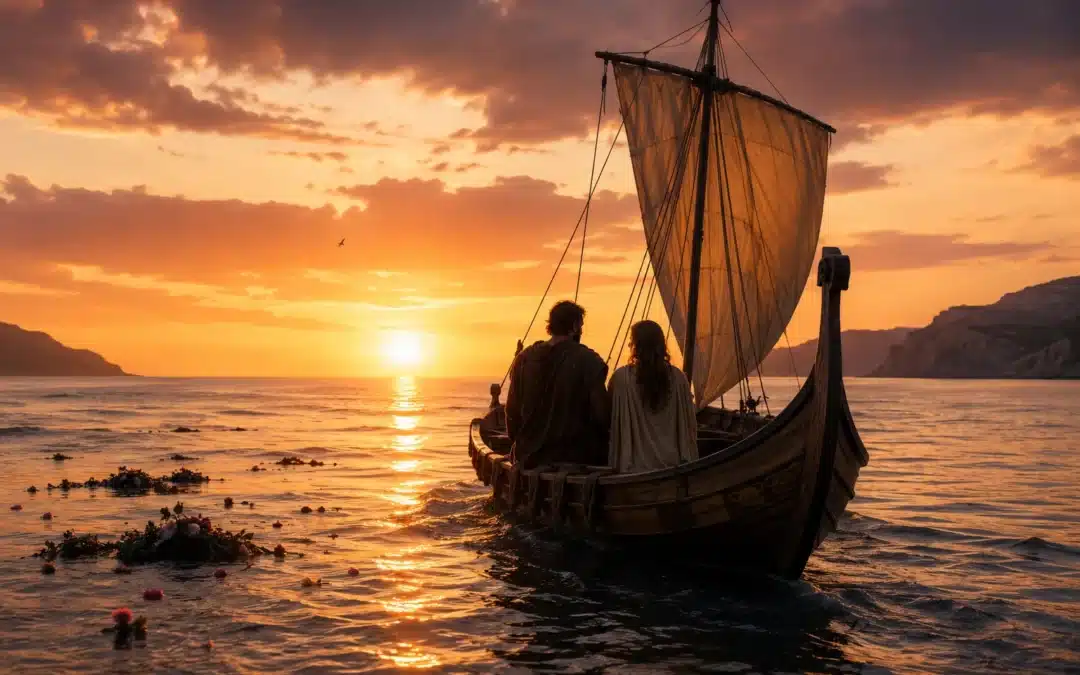
Penelope does not simply welcome Ulysses home; she invites him to sail with her into the future. Together they choose to face the unknown, honor the dead, and create a new life together.

It is an extraordinary ending because it refuses the fantasy that life can simply return to what it once was.

Both have been transformed.

Neither wishes to recover the old world.

Instead, they set sail together carrying memory, grief, responsibility, and a decision to love and to create something new.

To me, this is not only the conclusion of Ulysses’ journey.

It is a vision of what our own civilization might yet become.

Not a civilization that glorifies domination.

Not one that measures greatness by conquest.

But one mature enough to remember, and to feel remorse.

Mature enough to allow remorse to become not an endless expiation, but the beginning of wisdom.

Perhaps this is why The Odyssey has returned to us now.

Not to teach us how to conquer.

But to remind us that the highest achievement of a human being is not victory over others.

It is the courage to become someone who can create beauty after suffering, hospitality after fear, and love after violence.

If Antonio Mercurio was right, Ulysses’ greatest journey was never across the Mediterranean.

It was the journey from unconsciousness to consciousness; from domination to relationship; from power over self and others, to the exquisite kind of power we all have to choose to develop love.

If Christopher Nolan’s film is any indication, perhaps that is the journey humanity itself is now being invited to undertake.

And perhaps there could be no more fitting story for this extraordinary moment in history.

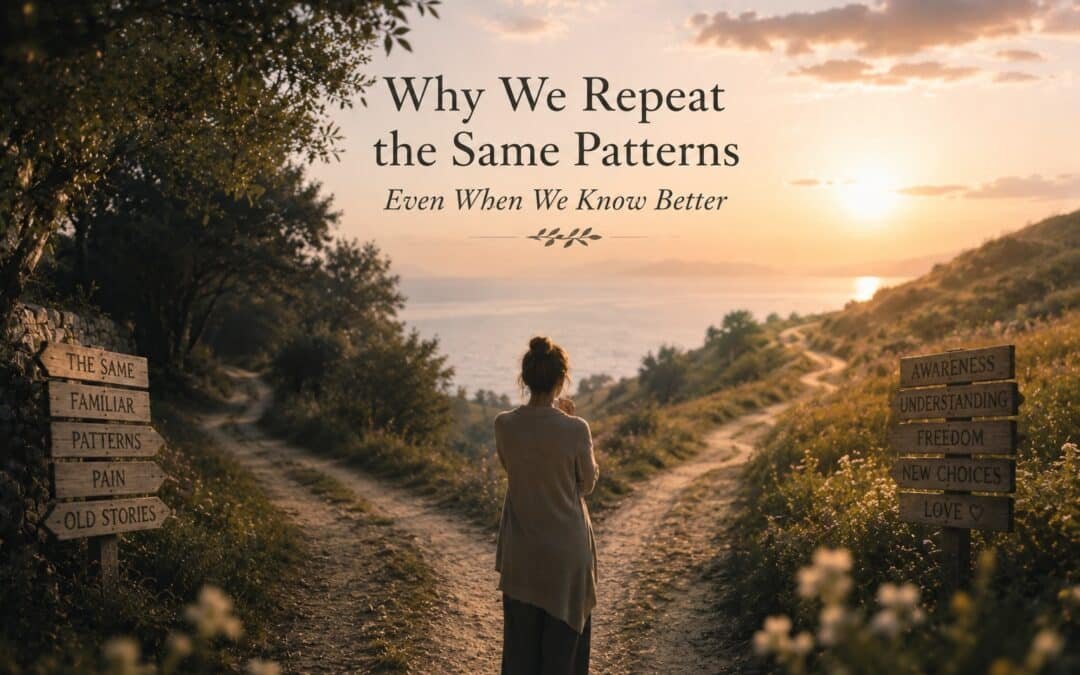
Why We Repeat the Same Patterns Even When We Know Better

Why We Repeat the Same Patterns Even When We Know Better

Have you ever found yourself saying,

“I knew this would happen.”

Or perhaps,

“Why do I keep ending up in the same situation?”

Most of us assume that once we understand something intellectually, we should naturally be able to change it. Yet life often tells a different story. We may recognize an unhealthy relationship, an exhausting work pattern, or a familiar emotional reaction, and still find ourselves repeating it.

This can leave us feeling frustrated, ashamed, or convinced that we simply lack enough willpower.

But what if repeating old patterns is not a sign of weakness or failure?

What if it is an invitation to understand ourselves more deeply?

We are shaped by more than conscious choice

Our lives are influenced by far more than our thoughts. We are shaped by our families, our early experiences, our relationships, our bodies, and often by patterns that were already present long before we were born.

Many of these influences operate quietly, beneath conscious awareness.

This is one reason insight alone is not always enough.

We may understand why we behave as we do and yet still feel pulled toward familiar ways of responding because they have become deeply woven into our lives.

Over the years, I have been struck by how many people come into counseling believing they simply lack willpower or are somehow “doing life wrong.” Yet as we begin exploring their family history, early relationships, and deeper emotional patterns, what once felt like a personal failure often begins to make much more sense. Understanding these patterns does not remove responsibility. Rather, it offers us greater freedom to respond to life with awareness, compassion, and choice.

Familiar does not always mean healthy

Human beings are naturally drawn toward what feels familiar.

Sometimes what feels familiar is loving, supportive, and life-giving.

At other times, what feels familiar may include criticism, emotional distance, over-responsibility, self-sacrifice, or the feeling that our worth depends upon meeting the expectations of others.

Without realizing it, we may recreate these experiences—not because we enjoy suffering, but because they have become the world we know.

Until these deeper patterns become visible, they often continue to shape our choices.

Bringing hidden patterns into awareness

One of the reasons I value Family Constellations is that they invite us to explore the larger family system in which we developed. Rather than focusing solely on the individual, they offer an opportunity to become more aware of unconscious loyalties, unresolved losses, and relationship patterns that may continue to influence our lives in ways we have never fully recognized.

This is not about blaming our families. Our parents—and their parents before them—were also shaped by beliefs, wounds, and ways of relating that were passed from one generation to the next.

Recognizing this does not mean that people are not responsible for the harm they may have caused. It does, however, invite us to see them within the larger context of their own lives and the family patterns that shaped them. This understanding does not excuse harmful behavior, but it can help us release unresolved pain, resentment, and misplaced guilt. As we become freer from these burdens, we are often better able to make conscious choices rather than unconsciously repeating the very patterns we long to leave behind.

Ultimately, Family Constellations are not about assigning blame or becoming trapped in the past. They are about seeing more clearly. When what has remained hidden begins to come into awareness, new possibilities for understanding, healing, and change can emerge. By understanding the forces that have shaped us, we become freer to respond to life with greater awareness, compassion, and intention, creating lives that are guided less by unconscious repetition and more by conscious choice.

Change begins with curiosity

Real and lasting change rarely begins with self-criticism.

More often, it begins with curiosity.

Instead of asking,

“What’s wrong with me?”

we might begin asking,

“What is this pattern trying to show me?”

That simple shift can transform the way we relate to ourselves. Rather than seeing ourselves as broken or defective, we begin to see ourselves as human beings whose lives have been shaped by experiences, relationships, and family histories that deserve to be understood with honesty and compassion.

Understanding the past is not about remaining focused on it. It is about becoming freer to create a different future—one guided not by unconscious repetition, but by greater awareness, authenticity, and love.

An Invitation

If you find yourself returning to the same relationship patterns, emotional struggles, or life situations despite your best intentions, perhaps it is time to explore them from a different perspective.

Upcoming Family Constellations Workshops:

On Saturday, July 18 the In-Person Familt Constellations Workshop will be held indoors, at 405 E Forest St in Oconomowoc, WI from 10-12:30.

On Sunday, August 23, I’ll be facilitating a Family Constellations Workshop in Southern Kettle Moraine State Park. Together we’ll explore how our family systems may continue to influence our lives and how greater awareness can open the door to new possibilities.

For those who wish, the morning will begin with an optional Guided Nature Immersion, offering a quiet opportunity to arrive more grounded and present before the workshop begins.

I’d love to welcome you.

If you’d like to learn more about Family Constellations or my upcoming workshop, click here.


And … I’d love to continue the conversation.

If this essay resonated with you, I invite you to share your thoughts or experiences in the comments below. Your reflections may also encourage others on their own journey.

Love,

Martha

The Double Spiral in Psychological and Spiritual Healing and Resilience

I have been thinking a lot about the symbol I chose for my new logo – the Double Spiral.

Symbols have been used by humans for millennia to elicit associations within our minds that then trigger thoughts, feelings and even actions.

Today the double spiral might not be as familiar to us as other symbols, such as religious ones like the cross for Christianity, or the 6 pointed star for Judaism, or – to use a modern symbol well known throughout the world, the golden arches of a fast food chain that tells us many things about modern culture (i.e. the speed that food can be prepared and served is more important than the quality of the food itself, etc.).

Nonetheless, although you may have never really noticed it before, the double spiral is an incredibly ancient symbol, and has been used by various cultures throughout the world through the millennia to inspire reflection on the continuous flow of opposites that we experience in our lives: day and night/light and darkness, life and death, the masculine principle and the feminine principle, what we experience inside ourselves and what instead we perceive coming from outside ourselves, etc. etc..

Sometimes it is shown lying horizontally, symbolizing the rising and setting of the sun, and thus the constant flow of life from day, to night, or from the birth of life to the end of it.

When it is instead depicted as in my logo, with its spiraling arms reaching up and down, it elicits a more psychological and spiritual idea of

the deeper we go in understanding our own inner selves, the roots of our lives in our experiential histories and realities, the higher we can go in our ability to experience the truth of life and the joy and “enlightenment” – literally reaching the light – that brings.

In other words, it urges us to remember that when we dig deep into the causes that lie behind our current experience of the world, good or bad, we become free and energized to experience the upward motion of the spiral, towards the light.

In essence, this simple symbol is telling us:

The deeper we dive into our darkness – the painful memories of past traumas, harms and hurts received that continue to drive our reactions in the present; the unaddressed mistakes and weaknesses we have shown; our repressed and often misplaced guilt and shame for our desires and dreams we were taught were wrong; the unprocessed anger and rage that we rightly felt as helpless children when we were harmed by our caregivers or by life itself, and that must be acknowledged and released in healthy ways because otherwise it poisons us – the more enlightened we can become.

The more we journey into our depths so we can embrace and heal the pain that lies hidden there, the freer we become to experience the Beauty of Life.

And not only does it remind us that the deeper we go, the higher we go; it also reminds us that this movement is constant, and does not necessarily happen at the same time. It requires that each movement is experienced separately.

We dive down: we are brought into feelings of pain, depression, despair, anger and rage, etc. by events in life or by our memories. We are flooded with all those difficult emotions; we are sometimes quite literally dragged through their “mud”.

But if we find the courage and the right kind of guidance, we can wade through it and gain important insights along the way. We can find new energy to make new choices and move back up towards the light. We can let go of our addictive patterns that keep us enslaved to unhealthy ways of thinking and acting, to toxic relationships, and all the other ways that the pain of our past continues to play out in our present.

And we move upward, toward the light of new understanding, new levels of love for ourselves, of responsibility and freedom and even joy.

Until the next time we need to dive back down, to release a bit more of our painful histories, or even some of the ancestral trauma we carry within our own hearts and minds. As we do so, the pain can still be great: the deeper we go, the deeper the pain can actually be.

But, the more adept we become at diving into old pain or even the new pain that can come through the kinds of losses and challenges we face in our current lives, the better we get at working through it, and deciding to use this complex energy to make new decisions, to create something new, to rise back up, within ourselves, towards the light.

This is a fine Art; it is the Art of transforming our pain into new life, our failures into new decisions, our traumas into new abilities to love ourselves and others in healthier, more evolved and enlightened ways.

And as we learn this delicate, difficult and yet incredibly inspiring Existential Art of dancing along the double spiral, we create our own Lives as a Work of Art. We become living examples of Life in how it transforms itself and how love and new, enlivened energies can truly be born from the deepest pits of desperation, destruction and despair.

I first learned about this symbol during a supervision I was doing with Antonio Mercurio. I was feeling a lot of despair for how hard it still was for me sometimes, even after decades of very intensive work on myself, to feel any kind of consistent levity of spirit. I was still often on the verge of despair, struggling inside myself to feel any real love for myself or my life. The pain of my early abandonment was still affecting me in many different ways, and it seemed as though my inability to “just get over it” was a clear indication of a failure on my part.

Antonio, instead, assured me that this was not the case. That if I was feeling that much pain, there were still lessons to be learned for it, that I simply was being invited to continue to dive in, and build those internal “muscles” I needed to be able to feel it all, and slowly release it. That if I had suffered so terribly, it meant that I was sensitive, not stupid, and that today my task was to be able to embrace these wounded parts of myself and love them back to health.

And then he told me about the Double Spiral, that he himself had learned about while reading Reinhold Niebuhr, and that had also helped him in his own journey, which was equally challenging, as he, too, was often drawn in very deeply and invited by his Self to clear out every little speck of fear, anger, lack of trust towards life, resentment and hatred and all the rest.

He encouraged me to spend some time and perhaps draw or paint this symbol, and he reminded me that I was not alone in my journey.

I indeed sat down right away after my session, and attempted to create an image that could express this concept of a double spiral where one arm reached down into the pits of my pain, and the other instead circled upwards, towards ever-higher and lighter feelings of freedom, creativity, presence and love. Those early attempts were pretty rudimentary and certainly nothing to show others, but they had a cathartic effect on me.

Sometime later, I found out that Niebuhr not only talked about the double spiral, but that he was also attributed with writing the Serenity Prayer, used widely first in Alcoholics Anonymous, and later in all the 12 step programs that followed in its footsteps. Today, the Serenity Prayer is something that many people here in the USA know about, even if they don’t know the actual prayer itself.

As a recovering person myself, I already knew the Serenity Prayer by heart, and for years I had considered it, and the 12 step approach, the second “pillar” of my own personal healing and evolution, along with the first which was my journey in Existential Personalistic and Cosmoartistic Anthropology.

I consider my path in EPA, in fact, the doorway that made it possible for me to not only develop myself professionally and become a counselor in that method as well as a licensed psychologist: perhaps most importantly, it opened my eyes, my heart and my mind to the reality of the spiritual dimension, and to the opportunity to develop this part of my Self without necessarily having to adhere to any kind of religion.

It helped me begin to open to broader concepts of “god” beyond those I had been raised with and that I had rejected many years before, which in turn allowed me to open up to the 12 step approach, and finally achieve lasting release from various ways my compulsive disorder had “disordered” me throughout my life.

These two pillars, in fact, along with then many other techniques that I have picked up along the way, continue to guide me as I go through my life, through the constant cycles of dipping down into the darkness of my personal and ancestral and even the collective history of humanity, to then lift back up into new levels of inspiration, love of myself of others and of life, of an increasing ability to receive the goodness and beauty that is also here, and to use the entirety of my journey as a service to the whole.

May you also find the strength and courage that you need to dive deep and embrace your wounds with loving compassion, so you can then rise back into your life with increasing confidence and wholeness.

It is not an easy journey, I know well – but undertaking a journey with the help and guidance of others who are doing it themselves, and who have also devoted considerable time, energy and money to learn how to help others, is truly an incredible experience.

That is what I decided to do, back in January of 1990 …. and since that moment, my life has taken a completely different trajectory than it would have otherwise.

I chose to heed the call of my soul to dive in deep…. and while the effort required to become truly Alive, no longer medicating myself or running from the pain in other ways, has sometimes felt daunting and impossible, it has brought me to a quality of life – both inner and outer – that I would have never dreamed possible.

Yes, it might mean feeling some pain sometimes, still …. and even feeling hopeless; when I am down in that lower spiral, it can still sometimes feel endlessly dark, lonely, and without any real purpose.

But with practice, I have learned that every dip “down” truly is followed by insights that then allow me to make new choices and move back up to the ascending spiral, and reach ever greater integration, awareness, agency and creativity. Joy.

It does take effort, and today I now know without any doubt that no one can do this work but me. We are each called to embrace our own lives, our own souls, and choose what we are going to do.

Every day we have a choice:

are we going to choose despair and hopelessness, or entrust ourselves completely to the beliefs and whims of others?

Even well meaning family, friends, medical professionals or even apps designed to rewire our brains cannot do the inner work for us. (And while yes, our brains need to be rewired and there is no question that using apps can help us “reprogram” ourselves, they can not give us the love we desperately need, that we can only receive from other beings that are alive and can engage in emotionally energized exchanges with us).

Or are we going to dive in, and choose to take new action and connect with others who can help us learn how to love ourselves, our lives, and Life itself in new, more life-enhancing ways – not because they are telling us what to do out of text-book learning (even though the learning is valid and important – but alone it is not infused with the emotional value of experience, which develops empathy and compassion), but because they know what the journey is like?

There are many ways we can choose Life over remaining stuck and suffering. Today, thanks to the many developments in psychological and spiritual understandings, informed also (but not replaced by) the incredible technological advances we are benefitting from, we have all kinds of philosophies, therapeutic approaches, practitioners and options to choose from.

For me, the one that has always excited me the most, and has offered a foundation for my own personal and professional growth even while exploring many other fascinating and helpful techniques (such as Family Constellations and Evolutionary/Transformational Astrology and Human Design), is Antonio Mercurio’s ideas around Life as a Work of Art (the link will take you to a page describing my new workshop – check it out, it might be a great way to start your journey), and if you have found my site, welcome.

I hope you find some inspiration and if you are looking for guidance and support I am more than happy to explore if working together could be a good fit.

Contact me to set up a free 15 minute chat, or you are also welcome to send me an email with any questions you may have. I always answer my emails, and usually manage to find time for sessions quite quickly, within a couple/few weeks at most. I look forward to hearing from you, and in any case wish you the very best in your own journey of healing, self discovery and unfoldment.

Life is Beautiful, and it is waiting for you.


Existential Creativity and Mindfulness

We are becoming ever more aware of how our inner lives and our mental health, often negatively programmed by our childhood experiences, affect our outer lives – and viceversa – and how we can improve them both by developing our existential creativity through holistic therapeutic approaches and mindfulness practices.

Over the last couple centuries, humanity has become ever more acutely aware of the importance of what happens in our early years. When we are children, we are like sponges, absorbing all kinds of information coming from both the external environment – our parents/caregivers, families, social environments, etc. – and from our inner selves – the thoughts, feelings, and sensations that we experience in our own minds and bodies.

The human journey is a complex and fascinating one, perhaps especially because each of us has an incredibly unique experience of it. Even though there are many things that we have in common with others, there is no “one size fits all” human experience.

This means that two children who grow up in the same home can have very different perceptions and experiences of that family, both because of how they are perceived by the others, and how they themselves experience and perceive their family members.

Whereas the current medical/psychological paradigm would like to be able to reduce all of our inner suffering to neurological processes, and thus easily solve our problems with pills, a holistic attitude goes beyond the purely physiological reality of our lives, and looks at the broader picture.

(Added note: It sounds like there is a big change coming in the general mindset around what mental illness actually is and how to treat it: I just heard today – January 29 , 2026 – that the newly revised edition of the DSM, the diagnostic manual used by mental health professionals and insurance companies to diagnose mental illnesses and establish treatment protocols, will include information on the potential causes of the various diagnoses described, including environmental ones such as family/cultural/socioeconomic environment and physical, psychological and emotional trauma. While there is no question that it is not easy to understand the causes behind the various types of suffering people can experience, there is also no question that to completely ignore the effects of childhood trauma and other environmental factors that clearly have lasting, and often extremely debilitating, effects, is absurd. But that is what mainstream mental health approaches have been doing for decades, which has only reinforced an incredibly myopic view of how we consider mental health, and of general wellness of our complex makeup which is an integrated reality of mental/emotional, physiological, existential/spiritual and environmental factors. Taking into account each of these factors is fundamental if we are to understand how to truly improve our overall health and ability to enjoy the experience of being alive. What a relief that finally the mainstream healthcare community here in the USA is beginning to change, and embrace the wisdom that those of us in the alternative and holistic healthcare sectors have been championing for decades!)

There is no question that when we are under emotional and even physical stress and pressure our brain chemistry can end up being altered, and cause us immense suffering, added onto the pain we experienced during the traumatic experiences themselves. All of this can become a vicious cycle, where our wounds from the past continue to live in the present, due to our own inner mechanisms that were originally designed to help us get through the trauma, but eventually keep us trapped within it.

This can happen at any time during our lifespan, although during childhood we are particularly malleable and vulnerable to the effects of stress, and the effects often don’t show up until much later (check out some of the emerging wisdom around CPTSD for more info on this: I find it fascinating that even just over these past couple years more and more healthcare practitioners are getting on board with the recognition that many mental health issues can be attributed to being exposed to traumatic experiences over time during childhood, and even the NHS has now published a “PTSD and CPTSD Self-Help Guide” , something unheard of even just a few years ago!).

But what are the solutions? It is actually pretty incredible to think that today, 128 years since the publication of Freud’s “Interpretation of Dreams”, which opened the door to an entirely new way of looking at the incredibly complex inner life of human beings, we have a vast “toolbox” that we can turn to, when we are trying to understand why we are suffering and what to do about it.

We often focus on the incredible technological discoveries humanity has made in these 130 years that have completely transformed how we live (the train-automobile-jet-spaceship, the radio-television-internet and now AI, etc. etc.); at the same time, there has been an incredible revolution regarding how we see our possibilities and limitations as human beings, within ourselves.

At the same time Freud was exploring his unconscious and opening the door to the inner life in the West, other kinds of inner explorers were creating new syntheses between Eastern and Western religious thought and experience. During the 20th century not only did the development of psychology, psychotherapy and neuroscience bring us tools for self-understanding and development that we could not have imagined earlier, but the merging of Eastern philosophies with Western ones brought about new ways of considering not only our own inner lives, but our connection to the greater life beyond our individual selves.

This emerging synthesis has brought about, for example, the practice of “Mindfulness”; the awareness that meditation and guided visualization, even when detached from any kind of religious dogma, are things we can learn to do that greatly enhance first of all the functioning of our brains, which then can lead to new decisions that bring us to better outcomes in our personal and professional lives, relationships and all the rest. More and more researchers and practitioners across many disciplines are delving into this increasing awareness, and offering up new “proofs” for insights that have been present within some religious traditions for millennia, and are just now reaching a more mainstream kind of recognition, across the globe. (One of the pioneering researchers in this area is Prof Richard Davidson at the University of Madison – go here to listen to an interesting talk that he gave on the Neuroscience of Mindfulness https://youtu.be/5pEw53YjsQA?si=5v_fMTTuHT3eFHMp).

One of the most important findings that Professor Davidson points out is that we can learn to increase our wellbeing, and that indeed, if we learn tools that will help us and practice them, over time our wellbeing increases.

This idea dovetails perfectly with the idea of Life as a Work of Art as conceived of by Antonio Mercurio, and which is at the basis of my holistic LifeArt counseling and coaching approach. This approach affirms that while we may come out of highly traumatic experiences, environments and situations that have left deep wounds within our psyches and our souls, and these wounds most definitely leave their marks on us, we do have the power to choose to learn new ways of thinking, acting and Being that will help us move into both feeling and living better, over time.

Any Art takes practice, and healing from our deep conditioning, that can be truly debilitating sometimes, and show up in persistent depression, anxiety and all kinds of problems, does often require that we look at many different types of support to get to a place where we can become increasingly autonomous and skilled in how we gradually learn how to give ourselves the love we so sorely lack. It is often a long, lifelong process.

But if we can embrace this process as an evolutionary journey, rather than as a kind of condemnation from an unjust universe, we can see that we are actually taking part in an incredible shift in the consciousness of humanity. Whereas even only a few decades ago we had few options at our disposal if we were suffering internally, today we have a vast array of practitioners, theories, techniques and approaches to help us along. Not only do we need to remain shuttered within our pain, feeling ashamed for our suffering, but we can find incredible opportunities for connection and reconnection with others who are also looking for – and finding – new ways not only of healing our early traumas, but of developing healthier, more vibrant and sustainable lives for ourselves, our children, and the opening the door for the generations to come.

Every time we make a decision to do something new, to face our pain with more loving kindness, getting some help in overcoming old patterns of thinking and acting that sometimes have been transmitted to us through the generations (check out my page on Family Constellations work for some insights on intergenerational conditioning), we are being existentially creative.

The term “existential” comes from the idea that our lives have meaning, but that it is up to us choose the meaning we want to give to it. We actually do have that freedom today, and as the great existentialist philosopher Sartre pointed out, this kind of freedom itself brings with it a certain kind of anguish.

But if we are brave enough to recognize that we actually do have this kind of freedom, however small it may feel to us, due to our circumstances and the kind of familial and/or cultural conditioning we may have been subjected to in the course of our lives, we also can soon discover that while many of our choices seem small indeed, each one we make that brings us more towards love of ourselves and others, rather than towards desperation, or resignation, or outright destructive judgment and abuse, helps us practice wellbeing, wellness and love.

For example, every time we manage to choose to notice when we are berating ourselves over a mistake we have made, and shift that inner voice to instead be kind and supportive; or every time we manage to see that after a disappointment we are attacking our spouse, rather than sitting with the pain of it, and stop before we do so, we are exercising our existential creativity. We are doing something new. We are practicing new ways of both connecting with our inner selves, that can lead us to new ways of interacting with others.

Becoming masters of our own lives is not something that happens over night, and even if we were raised in ideal families and circumstances, life has a way of throwing challenges and pain at us, that we are all called to address, sooner or later.

Rather than seeing these challenges as punishments, and seeing ourselves as helpless victims or martyrs, or feeling we have to instead figure out how to wield even more power over ourselves and others in an attempt to control everything, we can shift into a completely new way of seeing ourselves and life: as existentially creative beings, who can make new choices and even create great love and harmony out of our painful, and sometimes completely loveless, beginnings.

We can become Artists of life, and experience new ways of being, of interacting, of creating beauty, wellbeing and even prosperity for ourselves and others.

The old model of control and dominance is no longer necessary for our survival.

There is enough love and prosperity for everyone, and by learning how to develop our own ability to create the life we are longing for, we are contributing to the birth of a new human era.

Starting in February, I will be offering a workshop series, Life as a Work of Art Laboratories, where together we will explore a variety of tools to help us along in developing our own wellbeing, in alignment with the deeper purposes of life, and in awareness of how our own increased inner harmony and connectedness can contribute to the wellbeing of those around us. I hope to see you there, and if you have any questions about it, please feel free to contact me today for a free chat.