
Collective Unconscious or Morphic Fields? Two Ways of Understanding Human Connectedness

This article grew out of some reflections I shared in my essay When Ideas Appear at the Same Time in Different Places. It began as an AI-generated research summary, which I have reviewed, corrected, and edited. I am sharing it as a concise introduction to two fascinating theories rather than as original scholarship.

Understanding Jung’s Collective Unconscious

Carl Jung’s concept of the collective unconscious represents a significant aspect of his analytical psychology. Unlike the personal unconscious, which is unique to each individual and formed through personal experiences, the collective unconscious refers to a deeper level of the unconscious mind that is shared by all members of a species. It contains universal symbols and archetypes, which Jung described as inherited structures intrinsic to humanity, transcending cultural and individual differences.

These archetypes include motifs such as the Hero, the Mother, and the Shadow, which reflect the shared experiences and emotions present in human societies.

The implications of the collective unconscious extend beyond the individual psyche; they manifest in collective behaviors, beliefs, and the shared mythologies that form the cultural bedrock of societies across the globe.

Jung posited that this metamorphic field is responsible for the connections between people throughout the world, fostering understanding and cooperation, as these archetypes resonate with the shared human experience. The concept suggests that individuals are influenced by these deep-rooted symbols, shaping their emotions and behaviors in ways that can often be unconscious.

This idea aligns with a phenomenological approach, as it emphasizes the importance of subjective experience and shared human structures in understanding psychological phenomena. By recognizing these universal aspects of our consciousness, we can begin to appreciate the fractals of ideas and behaviors that connect us as a species.

Jung’s theory serves as a foundation for understanding how cultural narratives are formed and maintained over time, allowing us to analyze the ways in which we are linked through our shared unconscious heritage. In essence, the collective unconscious provides a framework for exploring the underlying patterns that influence both individual and societal dynamics.

Rupert Sheldrake’s Morphic Fields: An Overview

Rupert Sheldrake’s theory of morphic fields presents a revolutionary perspective on how nature and behavior are influenced by fields that store collective memories of species. According to Sheldrake, these morphic fields exist in a realm akin to the collective unconscious described by Carl Jung, as both suggest that there is a shared reservoir of knowledge that influences behavior across species.

However, Sheldrake diverges from Jung by introducing the concept of morphic resonance, which posits that these fields are not static but dynamic, capable of evolving over time as they encapsulate the experiences and behaviors of individual creatures within a species. This idea has significant implications, especially in understanding how patterns of behavior can repeat across generations without direct genetic influence.

The concept of morphic fields extends beyond mere behavioral patterns to suggest that they also play a crucial role in evolution. Sheldrake proposes that these fields help facilitate the development of new traits and behaviors through the collective experiences of past generations.

This challenges traditional views of evolutionary biology, where changes are primarily attributed to genetic mutations and natural selection. Instead, Sheldrake argues for a phenomenological approach, emphasizing the intricate web of connections between people throughout the world and species as they draw upon historical memories preserved in morphic fields.

Moreover, Sheldrake’s theory resonates with the notion of fractals of ideas and behaviors, highlighting how specific patterns repeat across different scales and contexts. Sheldrake’s morphic fields also provide a framework for understanding family constellations, as they suggest that behaviors and experiences may reverberate through familial lines, influenced by shared history.

Ultimately, Sheldrake’s morphic fields challenge established scientific paradigms, inviting researchers to explore the interconnectedness of all life forms and the ways in which knowledge and behavior are transmitted through these profound collective dimensions.

Comparative Analysis: Synergies and Divergences

The theories of Jung’s collective unconscious and Sheldrake’s morphic fields offer intriguing perspectives on the shared experiences and memories that permeate human consciousness and, arguably, other forms of life as well. At the core of Jung’s collective unconscious lies the assertion that there exists a repository of archetypal images and narratives that shapes human behavior across cultures and generations. This idea emphasizes a shared mental landscape that connects individuals through time and space. It is this collective repository that informs dreams, myths, and even instincts, creating a common thread among people worldwide.

On the other hand, Sheldrake’s morphic fields propose that patterns of behavior, knowledge, and memory are transmitted not through the conventional biological processes but rather through these fields which enable a form of memory that transcends individuals. In this view, learning and habits are not solely the results of direct experience but are influenced by these higher-order patterns. Thus, the morphic field serves as a connecting framework through which behavioral patterns emerge and evolve, akin to the fractals of ideas and behaviors that manifest across various species.

Despite these similarities, the two theories diverge significantly in their acceptance within the scientific community. Jung’s collective unconscious has encountered its share of skepticism and has often remained within the realm of psychology and philosophy, whereas Sheldrake’s morphic fields are viewed with even more caution, often critiqued for their lack of empirical support.

Furthermore, the metaphysical implications of these theories lead to different interpretations regarding the nature of memory and consciousness. While Jung’s unraveling of the unconscious emphasizes psychological integration, Sheldrake’s approach hints at a more interconnected universe, underscoring the phenomenological approach in understanding the connections between people throughout the world. The analysis of these theories reveals a complex landscape of consciousness that invites further exploration and discussion.

The Relevance of Jung and Sheldrake in Today’s Context

Jung’s idea posits that beneath the individualized consciousness exists a shared reservoir of experiences, memories, and archetypes common to all humanity.

This collective unconscious serves as a framework through which we can discuss the connections between people throughout the world, helping to explain shared symbols in art, myth, and religious practices.

As mental health practitioners increasingly adopt a phenomenological approach, they draw upon Jung’s ideas to better understand their clients within the broader context of societal influences and historical narratives.

Moreover, the relevance of Rupert Sheldrake’s concept of morphic fields resonates in the fields of biology and psychology. Sheldrake proposes that these fields govern the patterns and tendencies of behavior and development, influencing how organisms interact within their environments.

The concept of a metamorphic field extends beyond biology, suggesting that learning and behaviors are not merely learned individually but are shared among populations, echoing Jung’s collective unconscious.

By exploring metamorphic fields and family constellations, practitioners can address familial patterns and behaviors that transcend individual experiences, bringing to light their roots in collective memory.

As we navigate an increasingly complex world characterized by rapid technological advancement and global interconnectedness, Jung and Sheldrake’s theories provide essential perspectives on understanding consciousness, community, and individual identity.

Their ideas invite us to consider the fractals of ideas and behaviors that shape our experiences, hinting at a collective tapestry of human existence woven through shared memories and social interaction. The implications of these theories encourage a reflection on how we relate to one another, further enriching our comprehension of humanity in the modern age.
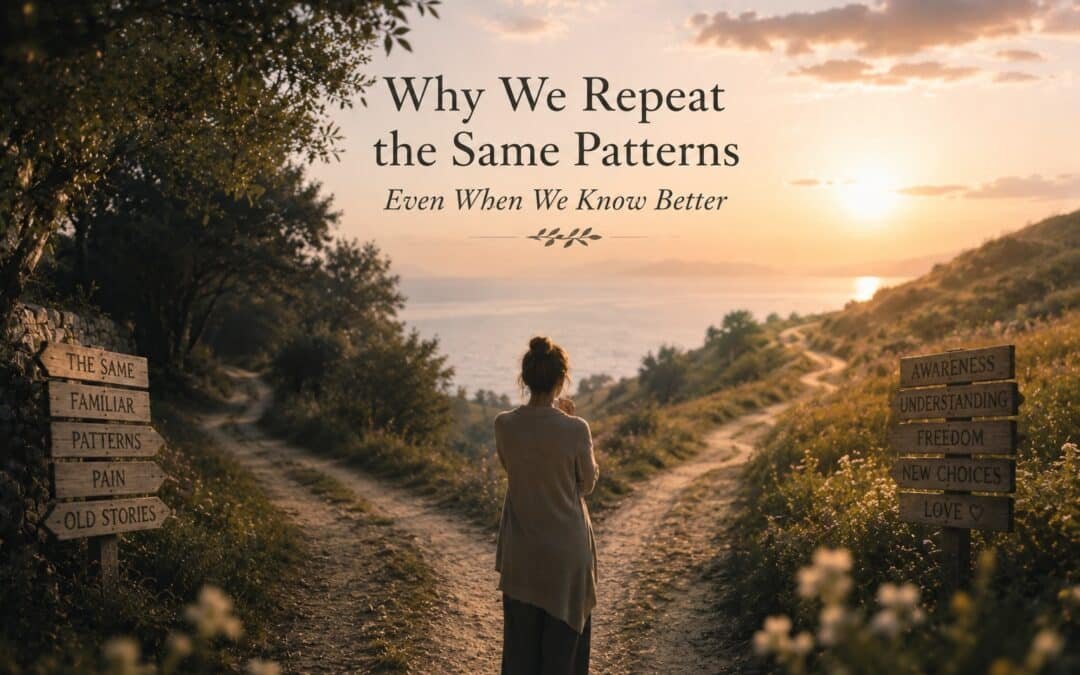
 

Why We Repeat the Same Patterns Even When We Know Better

Why We Repeat the Same Patterns Even When We Know Better

Have you ever found yourself saying,

“I knew this would happen.”

Or perhaps,

“Why do I keep ending up in the same situation?”

Most of us assume that once we understand something intellectually, we should naturally be able to change it. Yet life often tells a different story. We may recognize an unhealthy relationship, an exhausting work pattern, or a familiar emotional reaction, and still find ourselves repeating it.

This can leave us feeling frustrated, ashamed, or convinced that we simply lack enough willpower.

But what if repeating old patterns is not a sign of weakness or failure?

What if it is an invitation to understand ourselves more deeply?

We are shaped by more than conscious choice

Our lives are influenced by far more than our thoughts. We are shaped by our families, our early experiences, our relationships, our bodies, and often by patterns that were already present long before we were born.

Many of these influences operate quietly, beneath conscious awareness.

This is one reason insight alone is not always enough.

We may understand why we behave as we do and yet still feel pulled toward familiar ways of responding because they have become deeply woven into our lives.

Over the years, I have been struck by how many people come into counseling believing they simply lack willpower or are somehow “doing life wrong.” Yet as we begin exploring their family history, early relationships, and deeper emotional patterns, what once felt like a personal failure often begins to make much more sense. Understanding these patterns does not remove responsibility. Rather, it offers us greater freedom to respond to life with awareness, compassion, and choice.

Familiar does not always mean healthy

Human beings are naturally drawn toward what feels familiar.

Sometimes what feels familiar is loving, supportive, and life-giving.

At other times, what feels familiar may include criticism, emotional distance, over-responsibility, self-sacrifice, or the feeling that our worth depends upon meeting the expectations of others.

Without realizing it, we may recreate these experiences—not because we enjoy suffering, but because they have become the world we know.

Until these deeper patterns become visible, they often continue to shape our choices.

Bringing hidden patterns into awareness

One of the reasons I value Family Constellations is that they invite us to explore the larger family system in which we developed. Rather than focusing solely on the individual, they offer an opportunity to become more aware of unconscious loyalties, unresolved losses, and relationship patterns that may continue to influence our lives in ways we have never fully recognized.

This is not about blaming our families. Our parents—and their parents before them—were also shaped by beliefs, wounds, and ways of relating that were passed from one generation to the next.

Recognizing this does not mean that people are not responsible for the harm they may have caused. It does, however, invite us to see them within the larger context of their own lives and the family patterns that shaped them. This understanding does not excuse harmful behavior, but it can help us release unresolved pain, resentment, and misplaced guilt. As we become freer from these burdens, we are often better able to make conscious choices rather than unconsciously repeating the very patterns we long to leave behind.

Ultimately, Family Constellations are not about assigning blame or becoming trapped in the past. They are about seeing more clearly. When what has remained hidden begins to come into awareness, new possibilities for understanding, healing, and change can emerge. By understanding the forces that have shaped us, we become freer to respond to life with greater awareness, compassion, and intention, creating lives that are guided less by unconscious repetition and more by conscious choice.

Change begins with curiosity

Real and lasting change rarely begins with self-criticism.

More often, it begins with curiosity.

Instead of asking,

“What’s wrong with me?”

we might begin asking,

“What is this pattern trying to show me?”

That simple shift can transform the way we relate to ourselves. Rather than seeing ourselves as broken or defective, we begin to see ourselves as human beings whose lives have been shaped by experiences, relationships, and family histories that deserve to be understood with honesty and compassion.

Understanding the past is not about remaining focused on it. It is about becoming freer to create a different future—one guided not by unconscious repetition, but by greater awareness, authenticity, and love.

An Invitation

If you find yourself returning to the same relationship patterns, emotional struggles, or life situations despite your best intentions, perhaps it is time to explore them from a different perspective.

Upcoming Family Constellations Workshops:

On Saturday, July 18 the In-Person Familt Constellations Workshop will be held indoors, at 405 E Forest St in Oconomowoc, WI from 10-12:30.

On Sunday, August 23, I’ll be facilitating a Family Constellations Workshop in Southern Kettle Moraine State Park. Together we’ll explore how our family systems may continue to influence our lives and how greater awareness can open the door to new possibilities.

For those who wish, the morning will begin with an optional Guided Nature Immersion, offering a quiet opportunity to arrive more grounded and present before the workshop begins.

I’d love to welcome you.

If you’d like to learn more about Family Constellations or my upcoming workshop, click here.


And … I’d love to continue the conversation.

If this essay resonated with you, I invite you to share your thoughts or experiences in the comments below. Your reflections may also encourage others on their own journey.

Love,

Martha

Celebrating Human Progress at the time of the Solstice

 Happy Juneteenth!!

Happy Solstice!!

I wanted to share some musings on this moment in time and announce my upcoming In-Person Family Constellations Workshop on June 29. (For current information on my Family Constellations offerings go here).

As you probably know, the Solstice, the moment the Sun is found directly over the Tropic of Cancer, at 23.5 ° N Latitude, is tomorrow, and it marks the beginning of Summer in the Northern Hemisphere, and Winter in the Southern Hemisphere.  

For those living in the colder climates in the Northern Hemisphere, this is a particularly exciting time, with the Sun finally warming up the earth, urging nature to explode with enthusiasm!

I gave an AI image generator some prompts to describe the “relationship of the sun to the earth at the time of the summer solstice in the northern hemisphere”, and it came up with the image above. It certainly captures the excitement of the moment, and radiates hope and light!

This astronomical event was celebrated by traditional cultures around the globe and over the last few decades has again inspired many to consider it a holiday. 

Recently here in the USA more attention has finally been given to “Juneteenth” as well, which lands today, June 19, and is the Federal Holiday celebrating the freeing of the people held in slavery at the end of the Civil War.

Considered our “Second Independence Day” it seems fitting that it lands very close to the Summer Solstice. It is a celebration of the Light of Reason and Humanity after centuries of the darkness of slavery had both allowed for this incredible experiment in Democracy to bloom, thanks to the inexpensive labor provided by slaves in developing the land and commerce in profitable commodities like cotton and sugar, and tainted its economic and moral foundations. 

As I started writing my newsletter just now this correlation came to mind; it had never really occurred to me before. To be honest, I kind of assumed that as a white person I didn’t really have a right to celebrate Juneteenth. I figured it was a holiday reserved for the African Americans, and important to respect what it represents for them.

Instead, I am realizing this morning that this really is not true, because when anyone in a family, or a society, is suffering from abuse, the pain and dysfunction this causes affects the entire system. The entire system carries the imbalances caused, and the perpetrators, too, are often of victims themselves of distorted ways of thinking and acting. 

So just as any family system that is carrying unresolved pain and conflict tends to continue to express the dysfunction in one way or another, and negatively affect ALL its members, the pain and violence and general dysfunction woven throughout the origins of this magnificent nation is something that affects us all, even though we may not be fully aware of it. 

It is true we have come a long way, and we can see humanity’s progress in many ways, throughout not only this country, but throughout the globe. And we still have a long way to go. I imagine we always will; Life keeps urging us forward, asking us to grow into ever more integrated and evolved Being. 

It seems all the more important to remember this today, in 2024, so we can honor and celebrate how far we have come, and how far we have yet to go, to embrace the basic Truth that all human beings, within all families, within the USA and in all countries and cultures around the globe, are of equal value. No life has greater value than another. 
We are all very different, but different is not better, or worse. 

The culture of dominance and power and control, which allows for, and even encourages, the abuse of others – usually those we see as “different” or somehow inferior –  for personal gain, be that gain psychological, emotional or material/financial, is one that many of us are working hard to overcome, in many different ways.

Whether we are focused in our efforts to heal ourselves from our own individual and intergenerational traumas, which helps us gain a form of wellbeing that inevitably helps also those around us, although in indirect ways, or we are actively engaged in forms of service that impact the Whole in more extensive ways, every little effort, every little act of love, of healing, of simple recognition and honoring of another’s pain – of empathy and compassion – and of owning one’s own faults and correcting them, counts.

To be honest, I had no clue that I would end up writing these words when I sat down to send out my newsletter! My intent was mostly to just get out my announcement regarding my June Workshop! (My In Person Family Constellations Workshop is on June 29 – go here for more info and to sign up)

But as I have been writing this I have been realizing that indeed, Juneteenth is not just a celebration for the African Americans whose ancestors suffered directly from the horrors of slavery, but it is for all of us, who dream of an ever more beautiful, just, peaceful and enlightened world. It is a reminder of Dr. Martin Luther King’s famous words:

“The arc of the moral universe is long, but it bends towards justice”. 

So Happy Juneteenth to us all, and may the Solstice bring us warmth, hope, and light, so we can continue to move forward, one tiny step, one day at a time.

“Today is a new day, and I can choose to create Love, and I can choose to create Beauty, for myself and others”. (Antonio Mercurio)